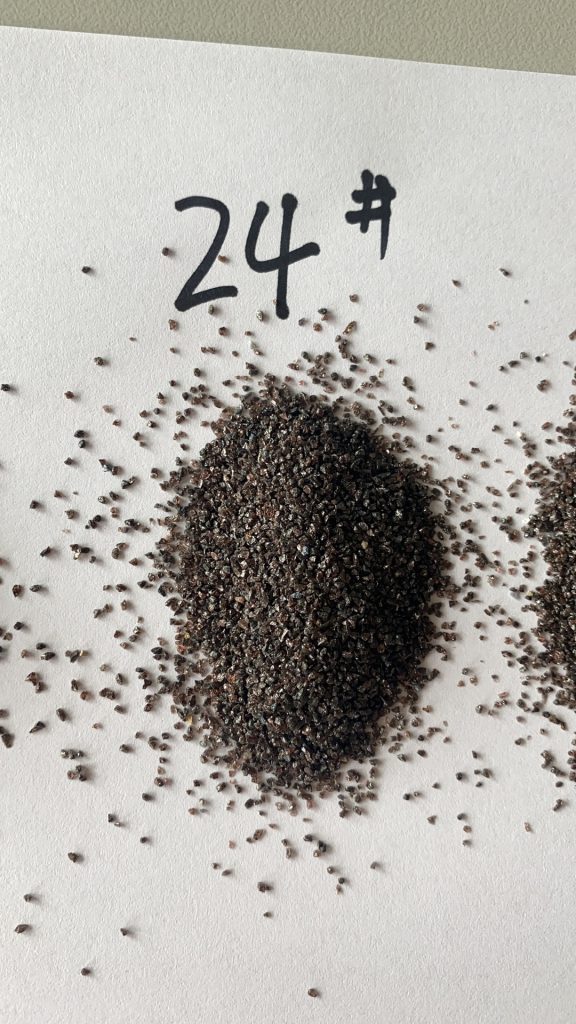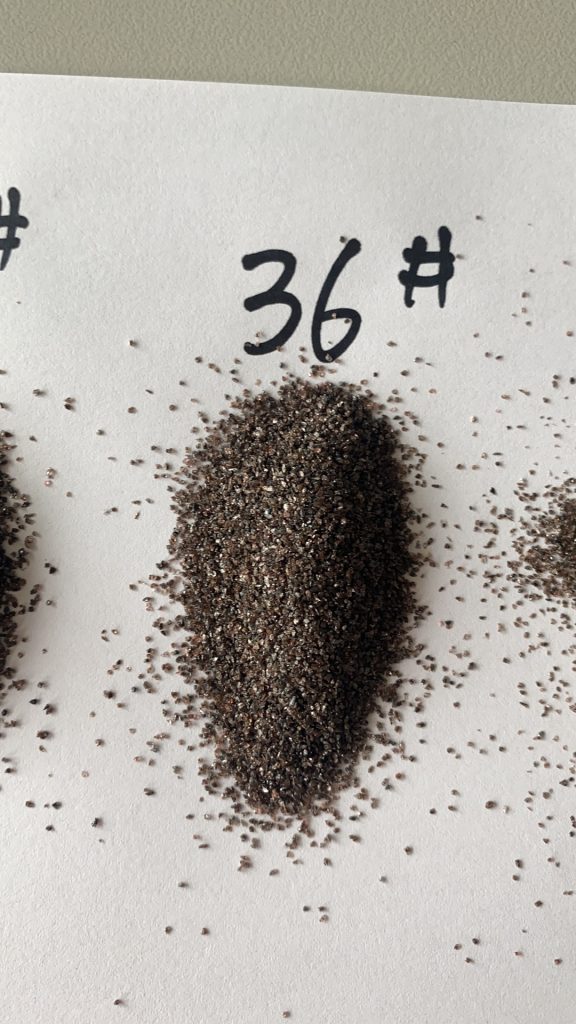
TECHNICAL GUIDE / 2026-10-02
Short answer. F24 and F36 are separate approved F grit models. Start with the required grade and distribution, then compare the published chemistry and model specific physical rows in their PDS files; validate performance in the actual process.
What is genuinely different
The CHAOYAN product catalog gives F24 and F36 distinct product records and individual PDS files. Both sit in the F grit family for bonded abrasives and surface preparation. The approved technical specification places both within the F8–F80 chemical band, while the magnetic content limit is model specific.
The shared chemical band does not make their grading interchangeable. The difference a buyer must verify is the grade and particle size distribution under the agreed standard. A wheel formulation or blasting result also depends on particle shape, bond or equipment settings.
| Check | F24 | F36 |
|---|---|---|
| Product record | Independent F24 page / PDS | Independent F36 page / PDS |
| Chemical band | F8–F80 published band | F8–F80 published band |
| Distribution | Agree F24 limits | Agree F36 limits |
How to compare samples
Ask both suppliers for the same grade designation and test basis, then record chemistry, magnetic content, size distribution and sample identity. If the goal is to change grade rather than supplier, keep all other process variables as stable as possible during the trial.
For blasting, define substrate, target profile, pressure, nozzle and reuse cycle. For a wheel, define bond, tool geometry, working material and target performance. This makes a grade comparison useful instead of anecdotal.
Selection guidance
Use F24 or F36 only when the process specification calls for it. Send the current grade, application, purchase quantity and acceptance sheet; ask for the exact model PDS and a labeled sample.
Common mistakes
- Treating the shared chemical range as evidence that F24 and F36 are the same grade.
- Changing grade and process settings together, then attributing the result to grit alone.
Frequently asked questions
Does F36 automatically produce a finer result than F24 in every process?
The grade designations differ, but the finished result must be validated in the actual tool or blasting process.
Are their chemical ranges identical?
The published specification groups both models in the F8–F80 chemical band; model specific physical and grading requirements still need checking.